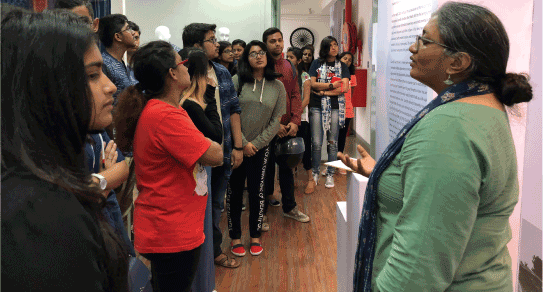
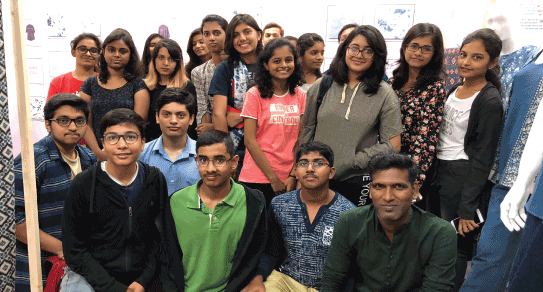
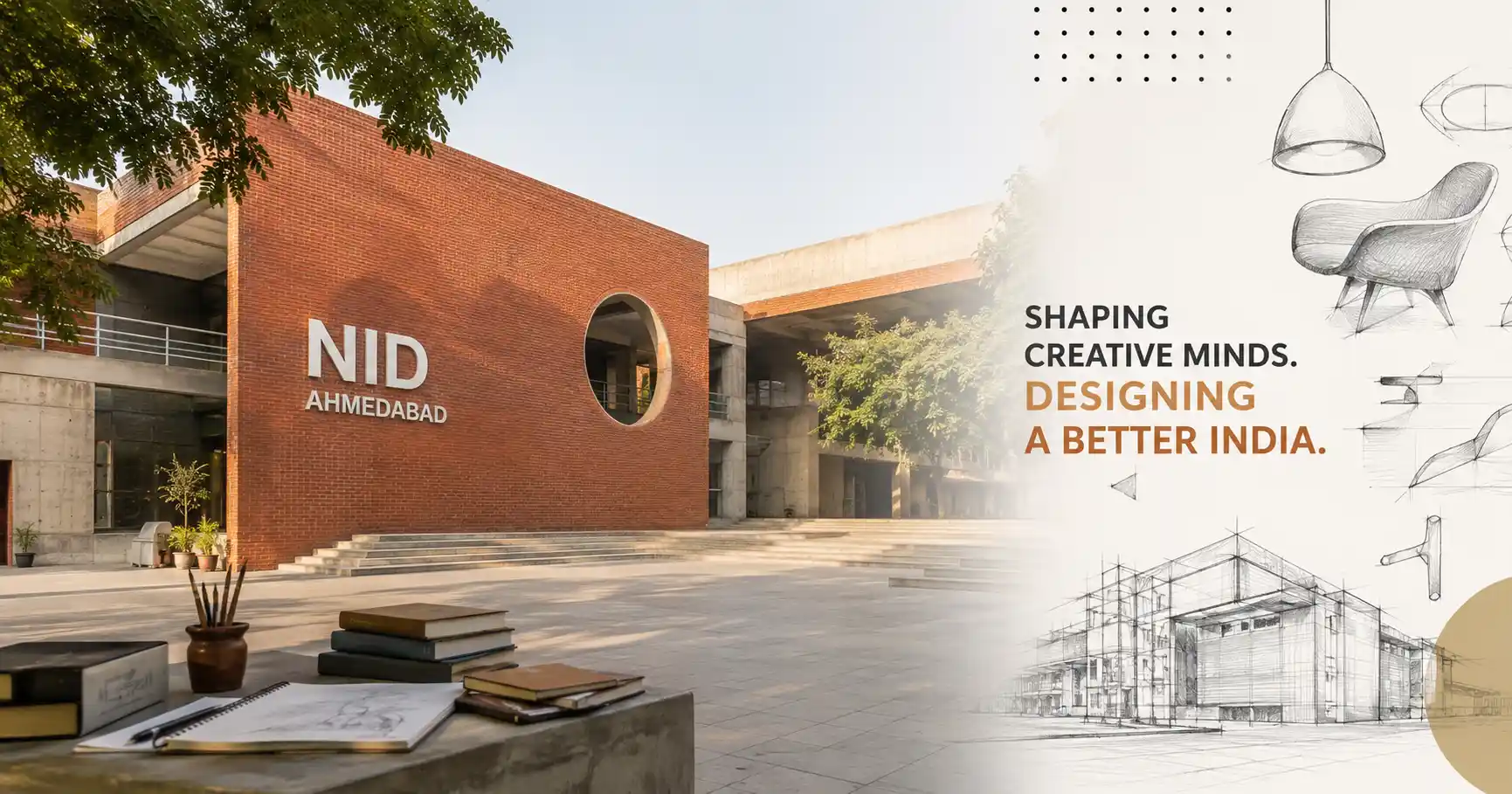
India’s design landscape has changed significantly over the years, with creativity, technology, and user-centred thinking becoming increasingly important across industries. At the heart of this transformation is NID Ahmedabad, an institution widely associated with the evolution of professional design education in the country. Its approach goes beyond teaching visual skills; it encourages students to understand people, culture, technology, materials, and real-world challenges before creating solutions.
The Evolution of Design Education in India
For a long time, formal education in India was largely focused on conventional academic and professional disciplines. Design was not always viewed as a structured career field with its own methodologies, research practices, and professional standards. The establishment and growth of the National Institute of Design Ahmedabad helped change that perception.
The institute introduced an educational philosophy in which learning was closely connected with observation, experimentation, making, and problem-solving. Instead of treating design simply as decoration or aesthetics, students were encouraged to consider functionality, usability, context, and social relevance.
This philosophy has had a lasting influence on design education in India. It has contributed to a broader understanding of design as a multidisciplinary field that can influence products, communication, services, spaces, digital experiences, and public systems.
Today, the demand for designers has expanded across sectors such as technology, automotive, healthcare, retail, entertainment, manufacturing, and social innovation. The educational model developed by leading design institutions has played an important role in preparing students for this changing professional environment.
How NID Ahmedabad Shapes Design Education
One of the most significant aspects of NID Ahmedabad design education is its emphasis on learning by doing. Students are not expected to depend entirely on textbooks or lectures. Workshops, studio assignments, projects, critiques, field studies, and collaborative exercises form an important part of the learning experience.
This practical approach helps students move through the complete design process—from identifying a problem and conducting research to generating concepts, developing prototypes, gathering feedback, and refining the final solution.
Another important contribution is interdisciplinary learning. Modern design problems rarely belong to one subject. A product designer may need knowledge of engineering and human behaviour, while a communication designer may need to understand digital technology, storytelling, and cultural context.
The learning environment therefore encourages students to explore different perspectives rather than limiting themselves to one narrow skill set. This has helped establish a model of design education in India where creativity is supported by research, critical thinking, experimentation, and technical understanding.
The institute’s legacy has also influenced how students, educators, and professionals think about the role of designers. A designer is increasingly expected to be a problem-solver and strategic thinker, not merely someone who produces visually appealing work.
NID Ahmedabad Courses and Areas of Specialisation
The range and structure of NID Ahmedabad courses reflect the changing requirements of the design profession. Students can explore disciplines connected with communication, industrial and product design, textiles, interaction, animation, and other emerging areas.
Rather than focusing only on software proficiency or individual artistic ability, these programmes generally encourage students to develop a broader design process. Research, ideation, visualisation, prototyping, presentation, and evaluation are all important components of becoming a well-rounded designer.
The strength of NID Ahmedabad courses also lies in their ability to connect foundational design principles with contemporary challenges. As technology continues to influence how people communicate, shop, work, travel, and access information, designers need to understand both human needs and technological possibilities.
This makes design education particularly relevant to students who want careers in creative industries as well as those interested in innovation, entrepreneurship, research, and design strategy.
For students and parents comparing design institutes, understanding the difference between simply learning design tools and receiving a comprehensive design education can be valuable. Institutions such as NID demonstrate why conceptual thinking and practical experience matter alongside technical skills.
Industry Exposure and Real-World Learning
A major NID Ahmedabad contribution to design education is the connection between classroom learning and professional practice. Design students benefit when academic projects reflect real challenges rather than existing only as theoretical exercises.
Exposure to industry helps students understand professional expectations, project constraints, client requirements, deadlines, teamwork, and user feedback. It also gives them an opportunity to see how design decisions affect businesses and communities.
This connection can help bridge the gap between education and employment. Students who have experience working through complex design briefs are often better prepared to communicate their ideas, defend their decisions, accept criticism, and adapt their solutions.
Industry interaction also keeps educational thinking connected to emerging developments. Areas such as user experience, digital products, service design, sustainability, and design research continue to evolve, making professional exposure an important part of contemporary design learning.
Research, Innovation and Social Impact
Design education becomes more meaningful when students learn to identify problems that affect real people. The institute’s approach has contributed to a culture in which research and observation are important parts of the creative process.
Students can investigate user behaviour, cultural practices, materials, environments, accessibility, and sustainability before developing solutions. This research-oriented approach encourages designers to ask better questions instead of immediately jumping to visual solutions.
Another important NID Ahmedabad contribution to design education is the idea that design can address social and environmental challenges. From improving everyday products to rethinking public services and communication systems, design can contribute to quality of life when it is grounded in genuine user needs.
This perspective is increasingly relevant as India addresses challenges involving sustainability, inclusive design, digital access, healthcare, urbanisation, and education. Designers trained to understand context can contribute more effectively to these complex areas.
The influence of this philosophy extends beyond the campus. Graduates and design professionals can carry research-led and human-centred approaches into companies, studios, startups, government initiatives, and independent practices. This creates a wider ripple effect across the country’s creative ecosystem.
Why the NID Ahmedabad Model Matters to Aspiring Designers
For students considering a career in design, the institution’s educational model offers an important lesson: becoming a designer is not simply about being creative. Professional design requires curiosity, discipline, empathy, analytical thinking, communication, and the willingness to experiment.
The NID Ahmedabad design education model demonstrates how these abilities can be developed through a combination of studio practice, research, collaboration, critique, and real-world problem-solving.
It also reinforces the importance of learning from failure. Design projects often involve multiple iterations before reaching an effective solution. Students learn to test ideas, recognise weaknesses, respond to feedback, and improve their work.
This mindset is useful well beyond design school. Whether a graduate enters product development, branding, user experience, animation, entrepreneurship, or design research, the ability to approach uncertain problems systematically can become a valuable professional advantage.
For organisations helping students explore higher education options, such as Ignite India Education, understanding this educational philosophy can make conversations about design careers more meaningful and informed.
Explore More: Best clat course | UCEED coaching | NID Coaching
The Wider Impact on India’s Design Ecosystem
The influence of the National Institute of Design Ahmedabad can be viewed through the larger development of India’s design ecosystem. As more businesses recognise the importance of customer experience, product usability, branding, innovation, and digital interaction, the role of professionally trained designers has become increasingly visible.
The institute’s influence can be broadly understood through:
- Encouraging multidisciplinary and project-based learning.
- Promoting research, experimentation, prototyping, and critical thinking.
- Preparing students to address practical industry and social challenges.
- Strengthening the professional identity of design as a career.
- Inspiring innovation across products, services, communication, and digital experiences.
These developments have contributed to a stronger foundation for design education in India, where students are increasingly exposed to both creative exploration and structured problem-solving.
What Makes NID Ahmedabad Courses Relevant Today?
The design profession is constantly changing. Artificial intelligence, digital interfaces, sustainable materials, immersive media, and new manufacturing technologies are creating new opportunities while also introducing new challenges.
This makes adaptability one of the most important qualities for today’s designers. The value of NID Ahmedabad courses is therefore not limited to the specific tools or techniques students learn during their academic journey. A strong design education should equip students with the ability to continue learning as technologies and user expectations change. Ignite India Education recognizes the importance of this adaptable approach to design education.
This approach is particularly valuable in a country as diverse as India. Designers may work with users from different languages, cultures, income groups, regions, and accessibility needs. Understanding context becomes just as important as producing an attractive final output.
Conclusion
The story of NID Ahmedabad is closely connected with the development of professional design learning in the country. By combining creativity with research, practical experimentation, interdisciplinary thinking, and social awareness, the institute has helped shape how design is understood and taught.
Its influence demonstrates that effective design education is not simply about mastering creative software or producing attractive portfolios. It is about learning how to observe, question, research, create, test, and improve solutions for real people.
As India’s industries continue to embrace innovation and user-centred thinking, the principles associated with NID Ahmedabad remain relevant for the next generation of designers. Its broader contribution lies in helping establish design as a serious discipline capable of creating value for businesses, communities, and society.
Frequently Asked Questions
1. Why is NID Ahmedabad important for design education?
It helped establish a multidisciplinary, practical, research-oriented approach to professional design learning in India.
2. What are the major NID Ahmedabad courses?
Its programmes cover areas such as communication, industrial and product design, textiles, interaction, animation, and related design disciplines.
3. How does NID contribute to industry readiness?
Through project-based learning, practical assignments, critiques, collaboration, and exposure to real-world design challenges.
4. Is design education useful beyond creative careers?
Yes. Design thinking develops problem-solving, research, communication, innovation, and user-centred thinking skills applicable across industries.
5. What is the biggest NID Ahmedabad contribution to design education?
Its major contribution is promoting design as a multidisciplinary problem-solving discipline rather than treating it only as an artistic or visual field.














 Login with Google